01
Every verdict shows its evidence
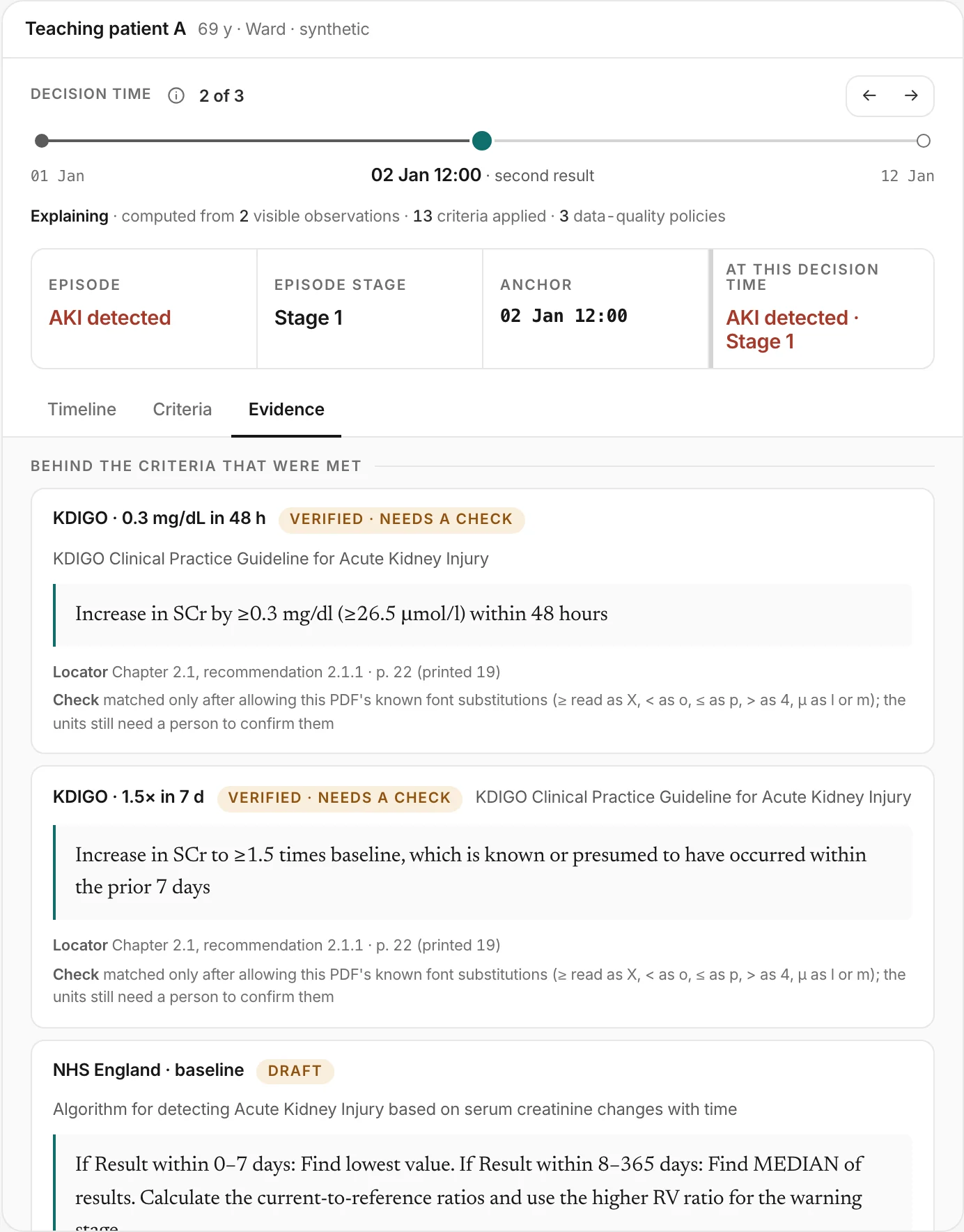
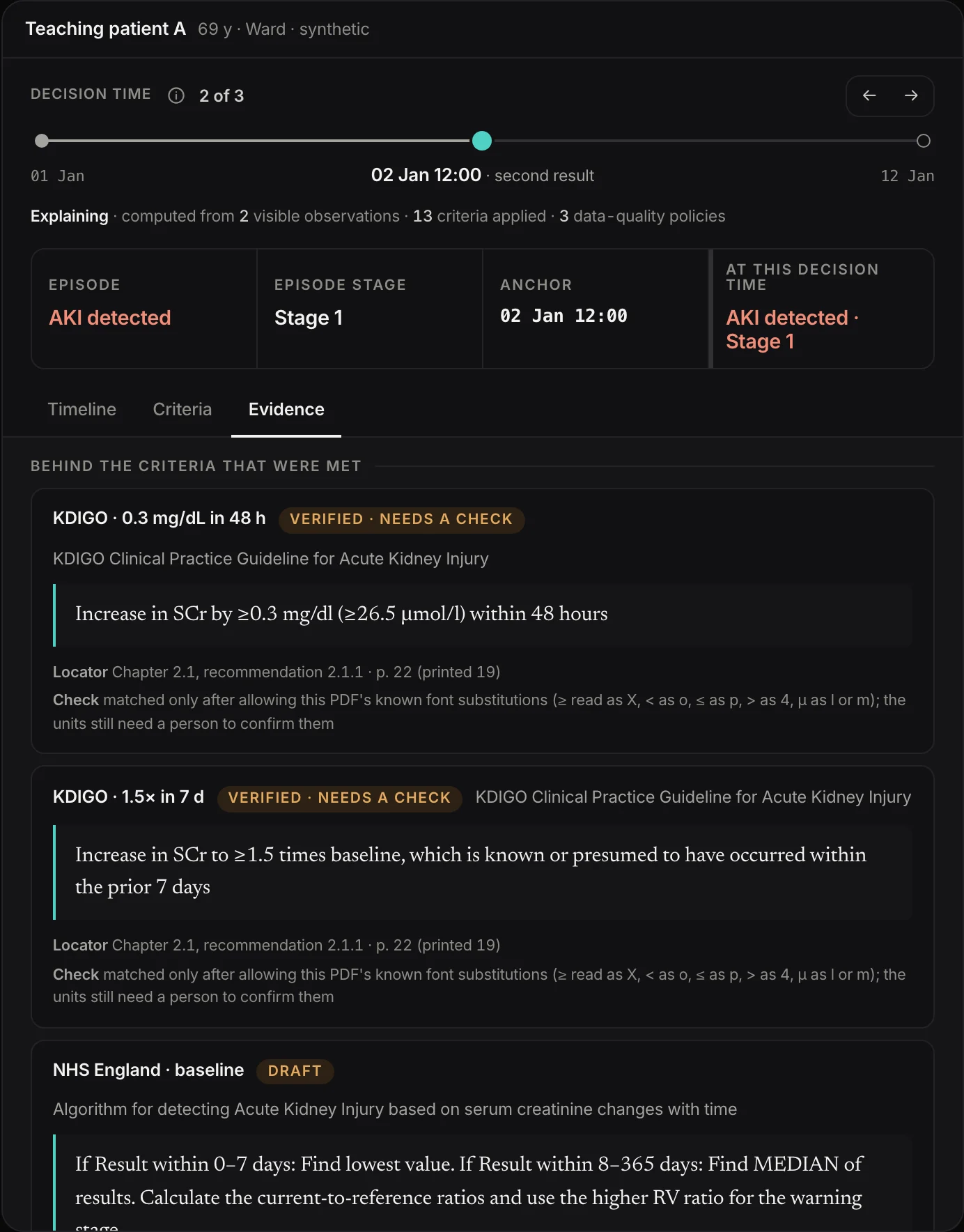
The Evidence tab lists the guideline passages behind the criteria that were met, word for word, with the page they come from and whether a person has checked them yet.
Research prototype · Clinical reasoning over time
TIMELY AGENT answers questions about a patient's record using only what had been recorded by the decision time. A deterministic engine applies the guideline's criteria, and every verdict quotes the passage it rests on.
Synthetic records only · Not a medical device
01The problem
A result reported at noon cannot explain a decision made at ten, yet a record read after the fact mixes what was known at the time with what came later.
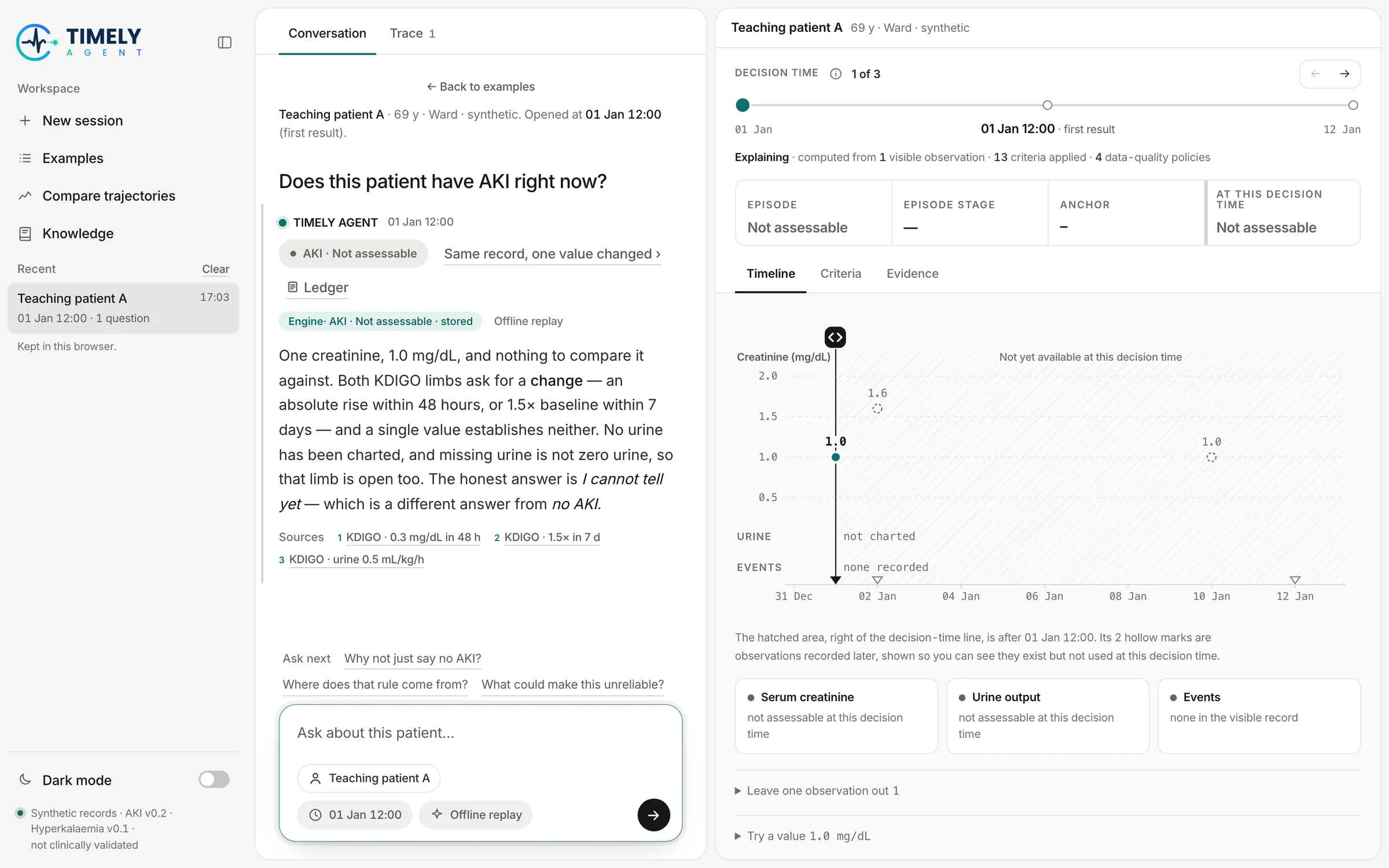
TIMELY AGENT fixes the decision time first and reads only what had been recorded by then. A later result stays out of view, and a criterion that cannot be judged from what is there is reported as not assessable rather than guessed.
02How it works
Each condition is a knowledge pack: criteria, time windows and data-quality policies. Every rule cites a verbatim passage of the published guideline, with its page and a hash of the document it was checked against.
The record is read at the decision time. A result recorded after it is out of view, however much it would have helped.
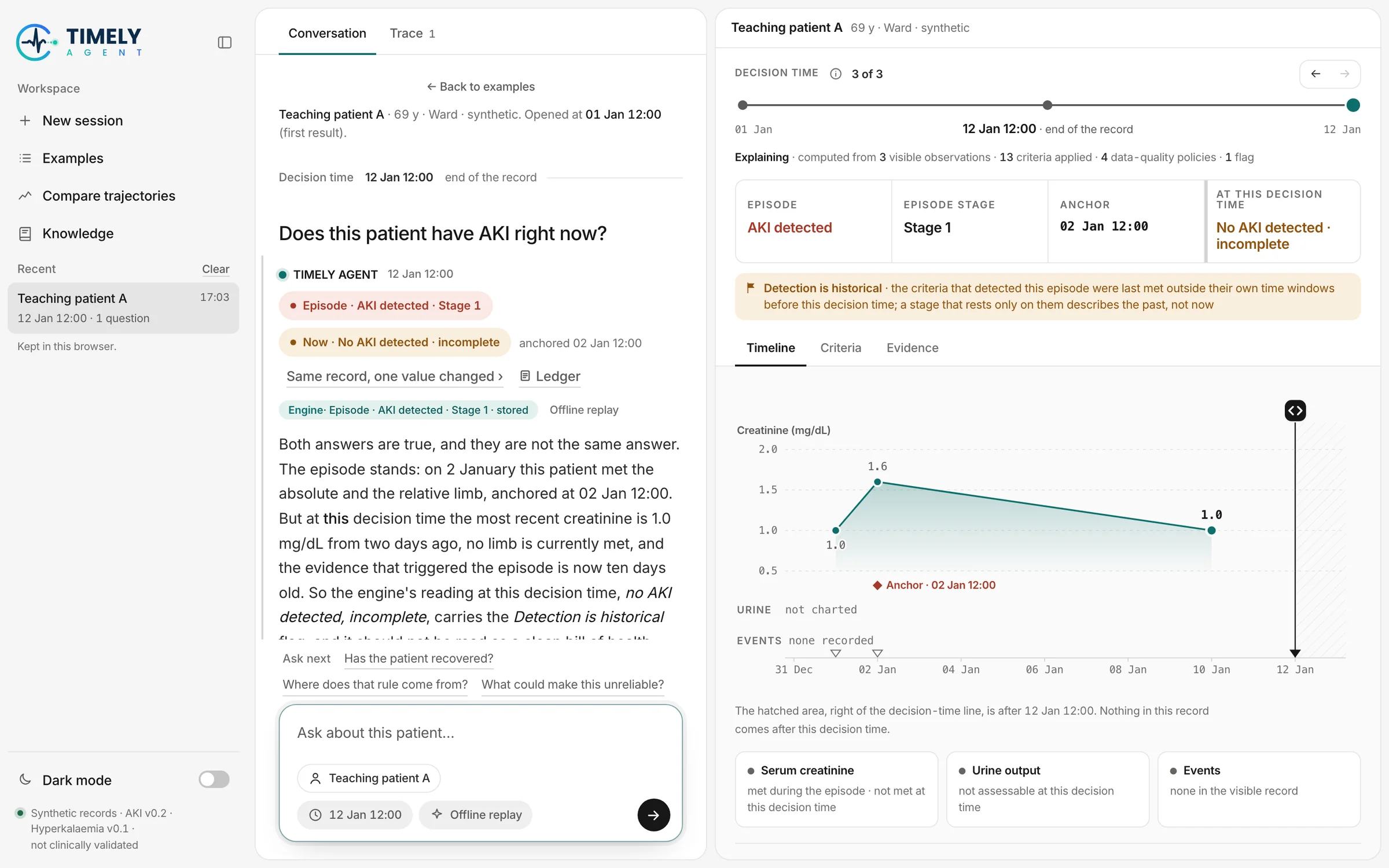
The engine evaluates every criterion as met, not met or not assessable, and names the data-quality policies it applied. The same record at the same decision time always gives the same verdict.
The model chooses which tools to call and writes its answer with placeholders. The values are filled in on the machine that holds the record, and every request that leaves it is fingerprinted and logged.
The record, the knowledge, the engine and the result each carry a hash. A replay file reruns the engine on a synthetic record and checks every link.
03The demo
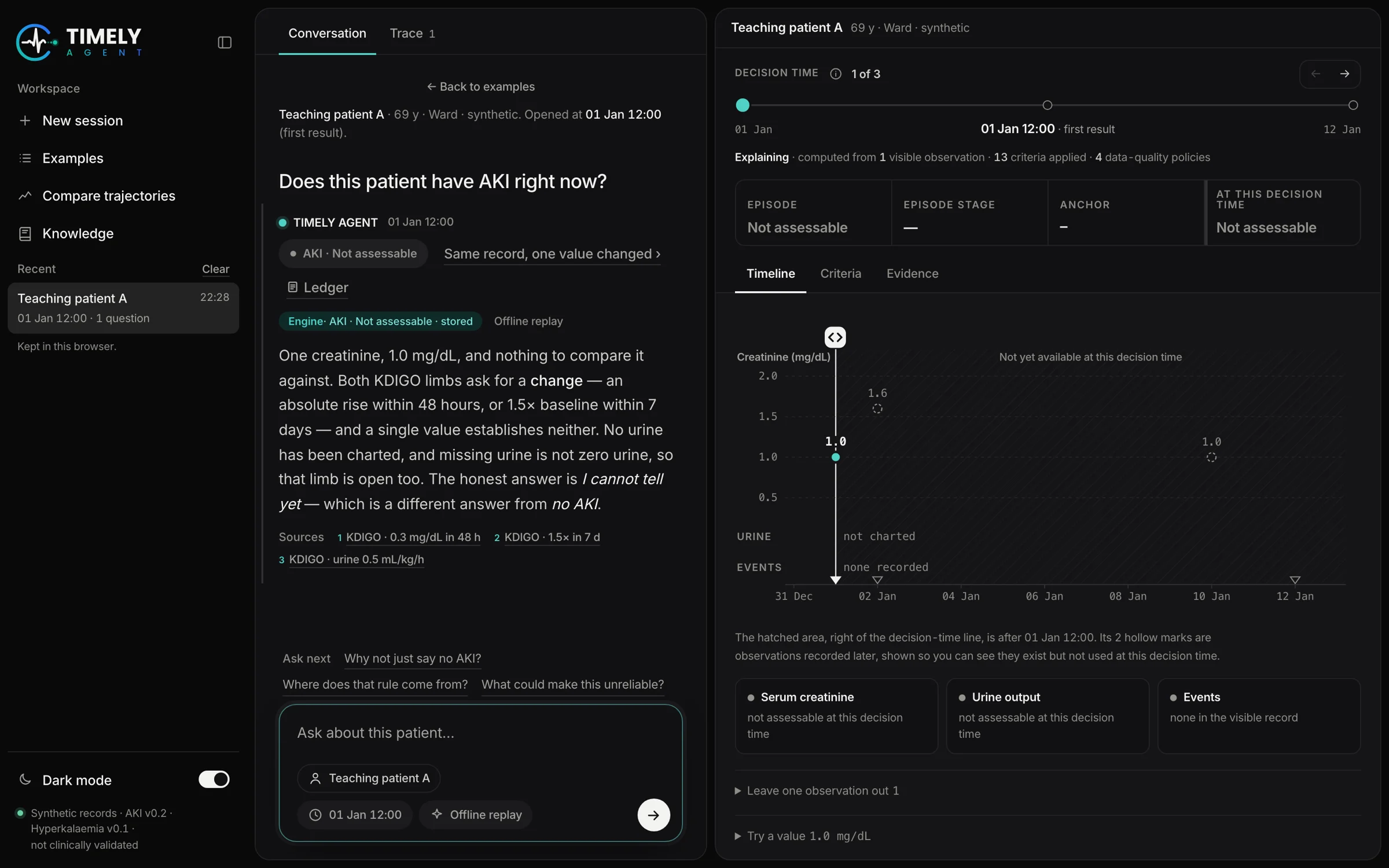
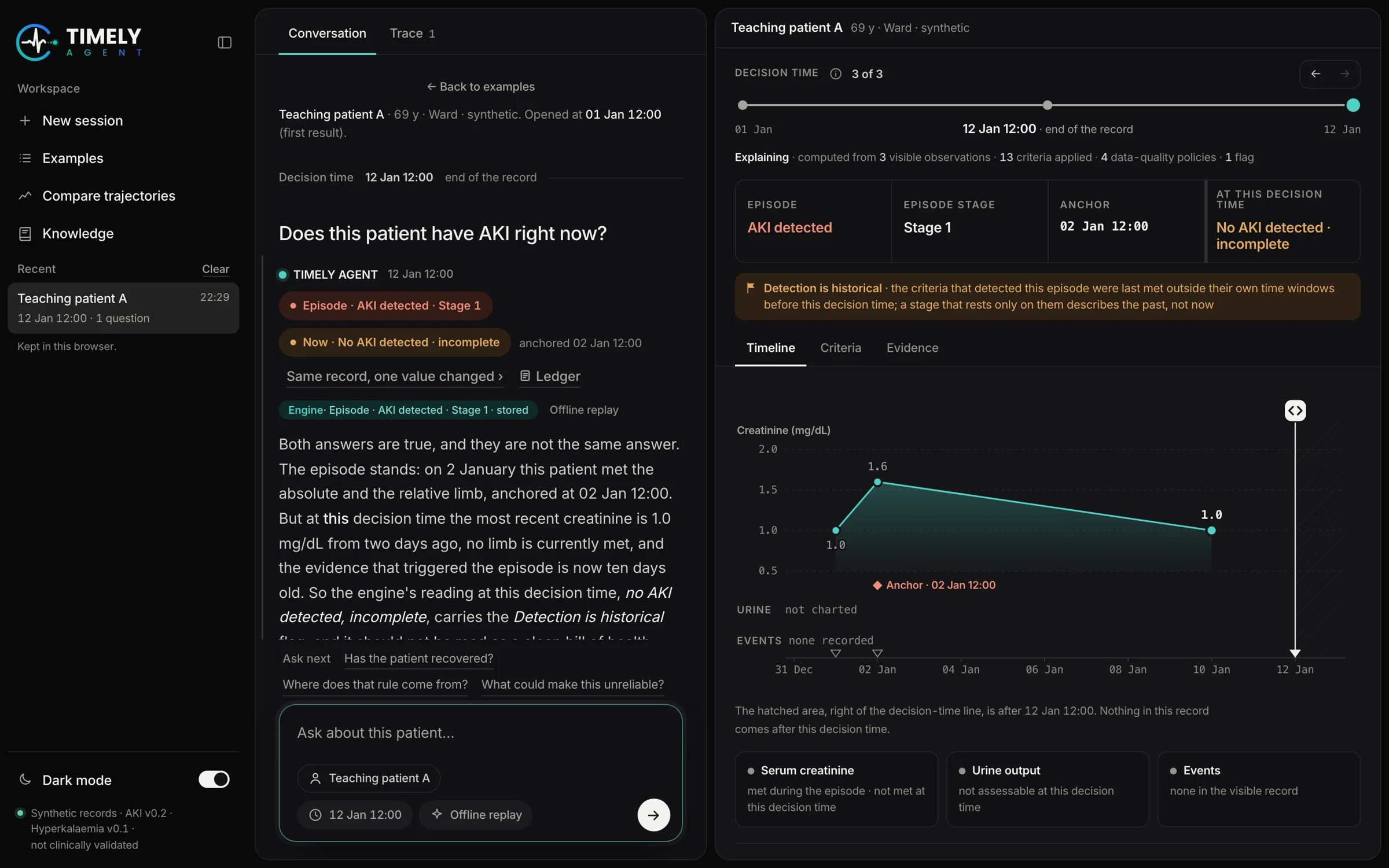
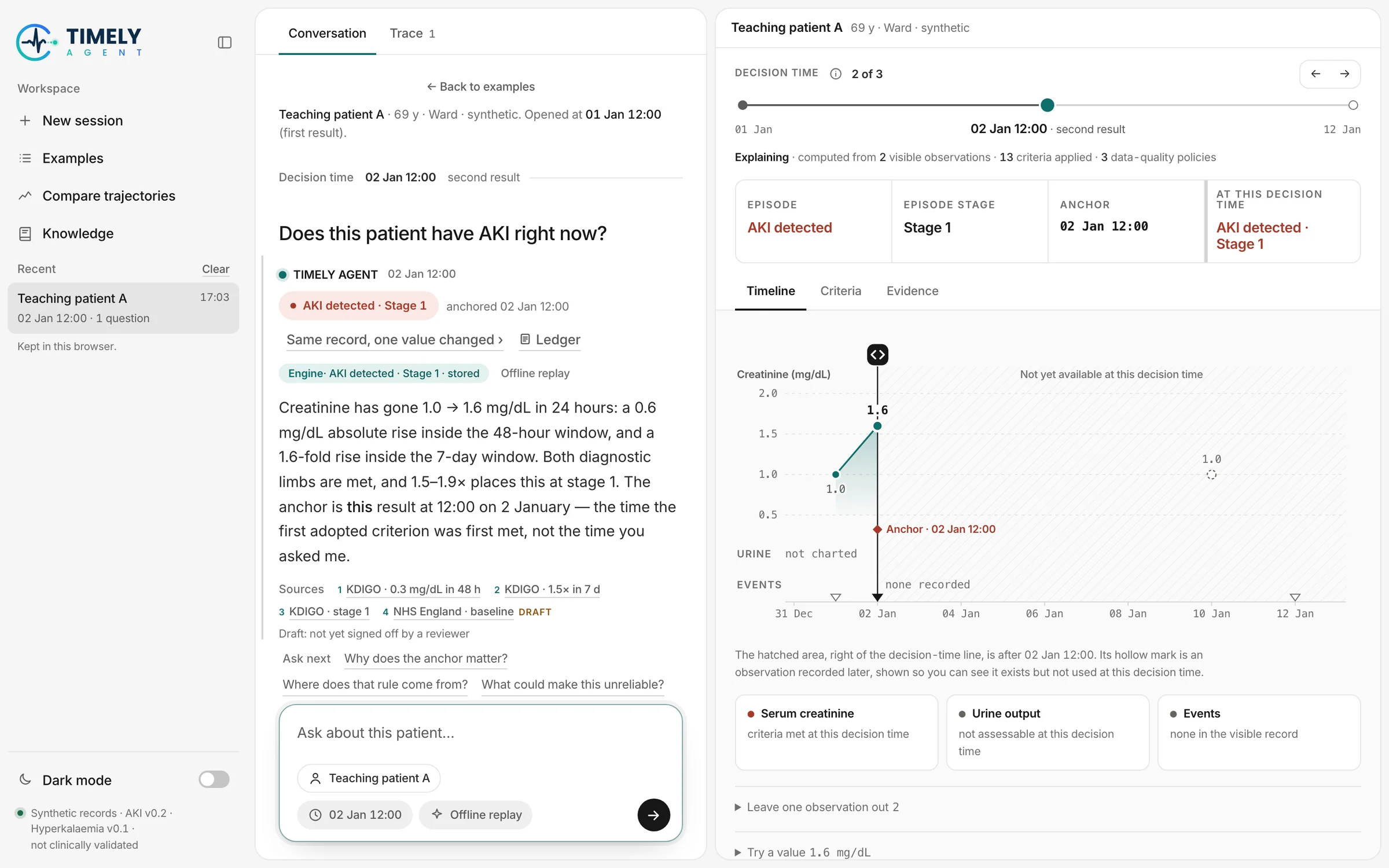
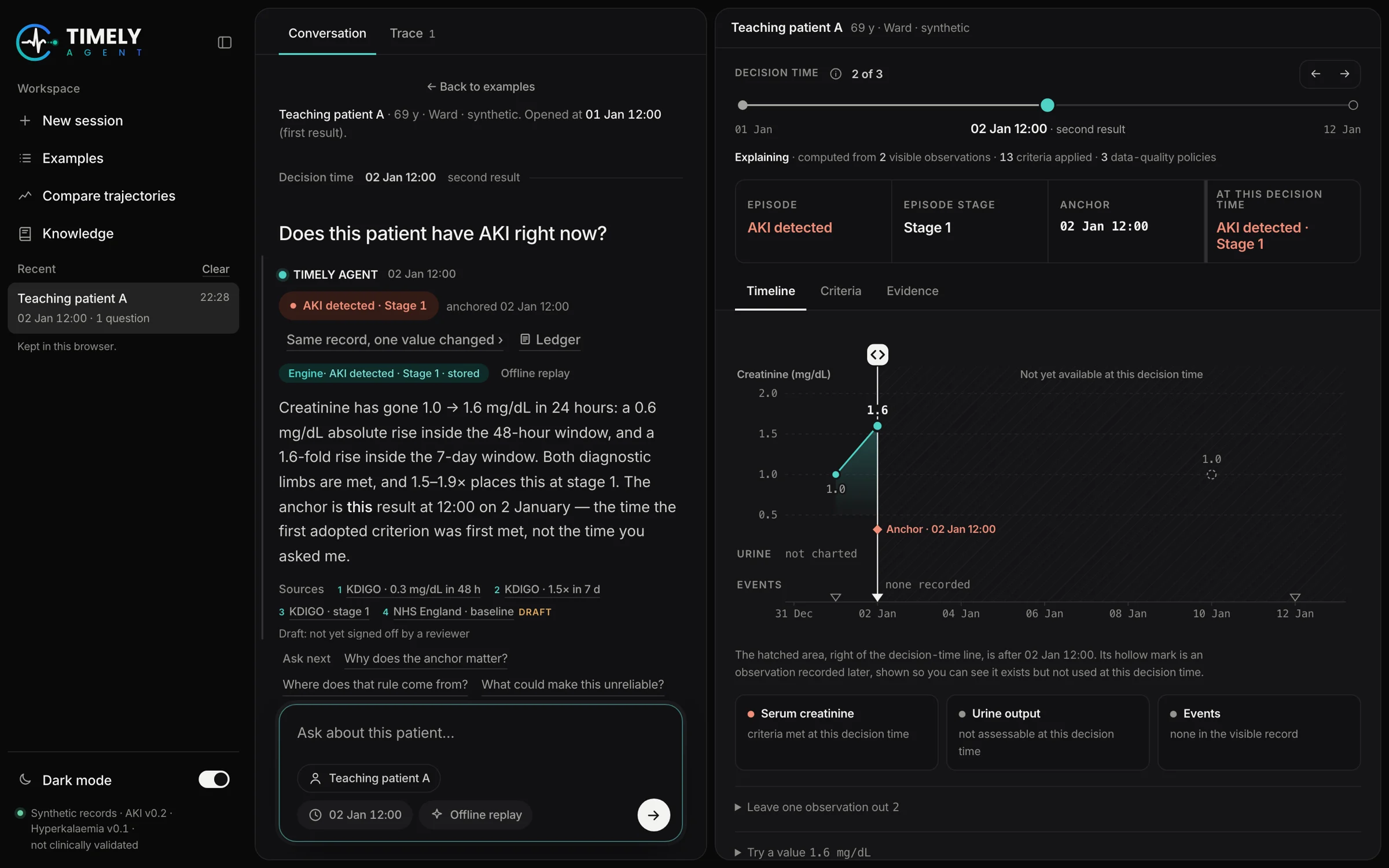
The demo opens on synthetic teaching records. It runs in the browser as a replay of the engine's stored results; the live agent runs on a local server. The images below are screens from it.
01
The Evidence tab lists the guideline passages behind the criteria that were met, word for word, with the page they come from and whether a person has checked them yet.
02
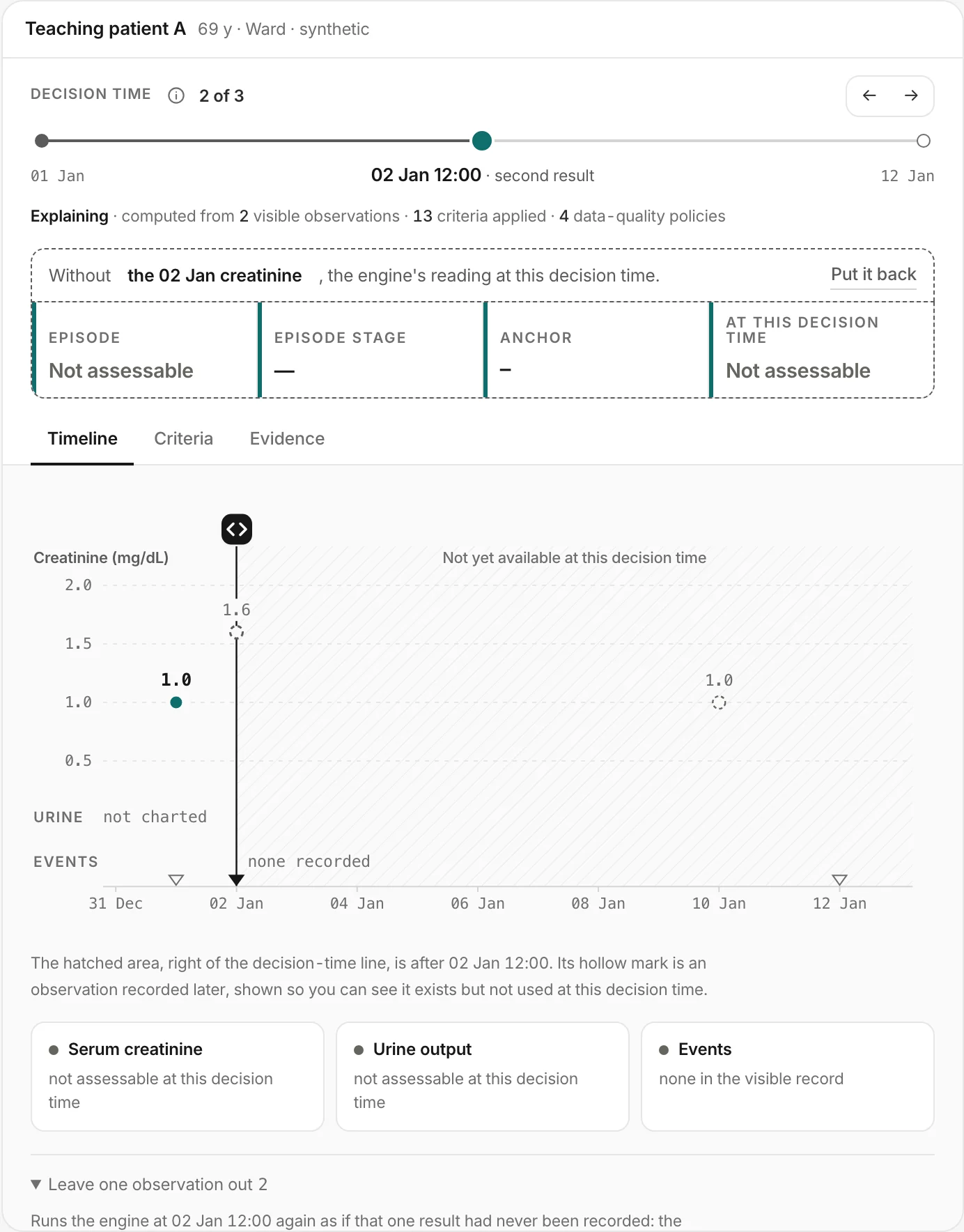
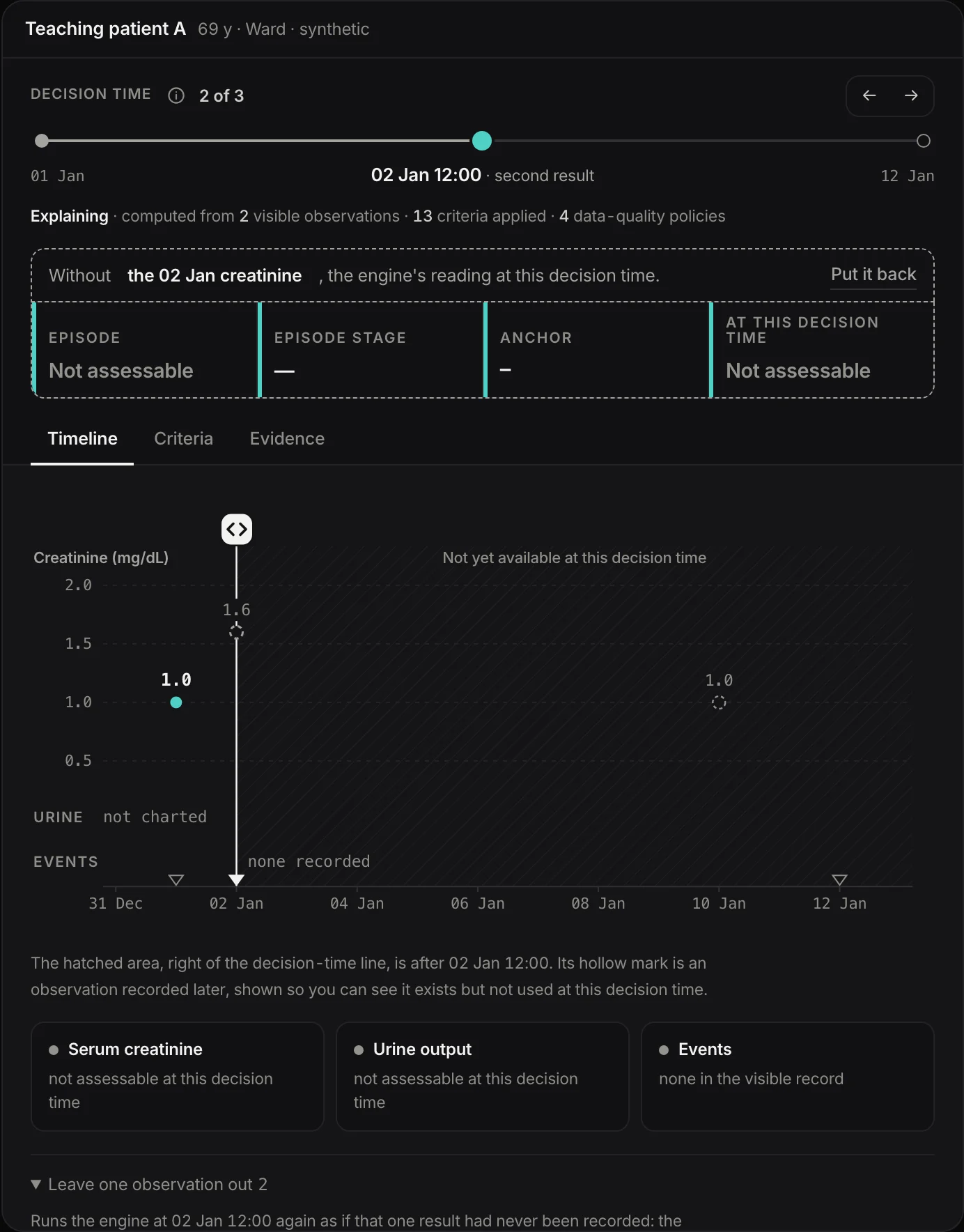
Leave an observation out and the engine reads the record again without it. The reading takes the verdict's place, marked hypothetical, until you put the observation back.
03
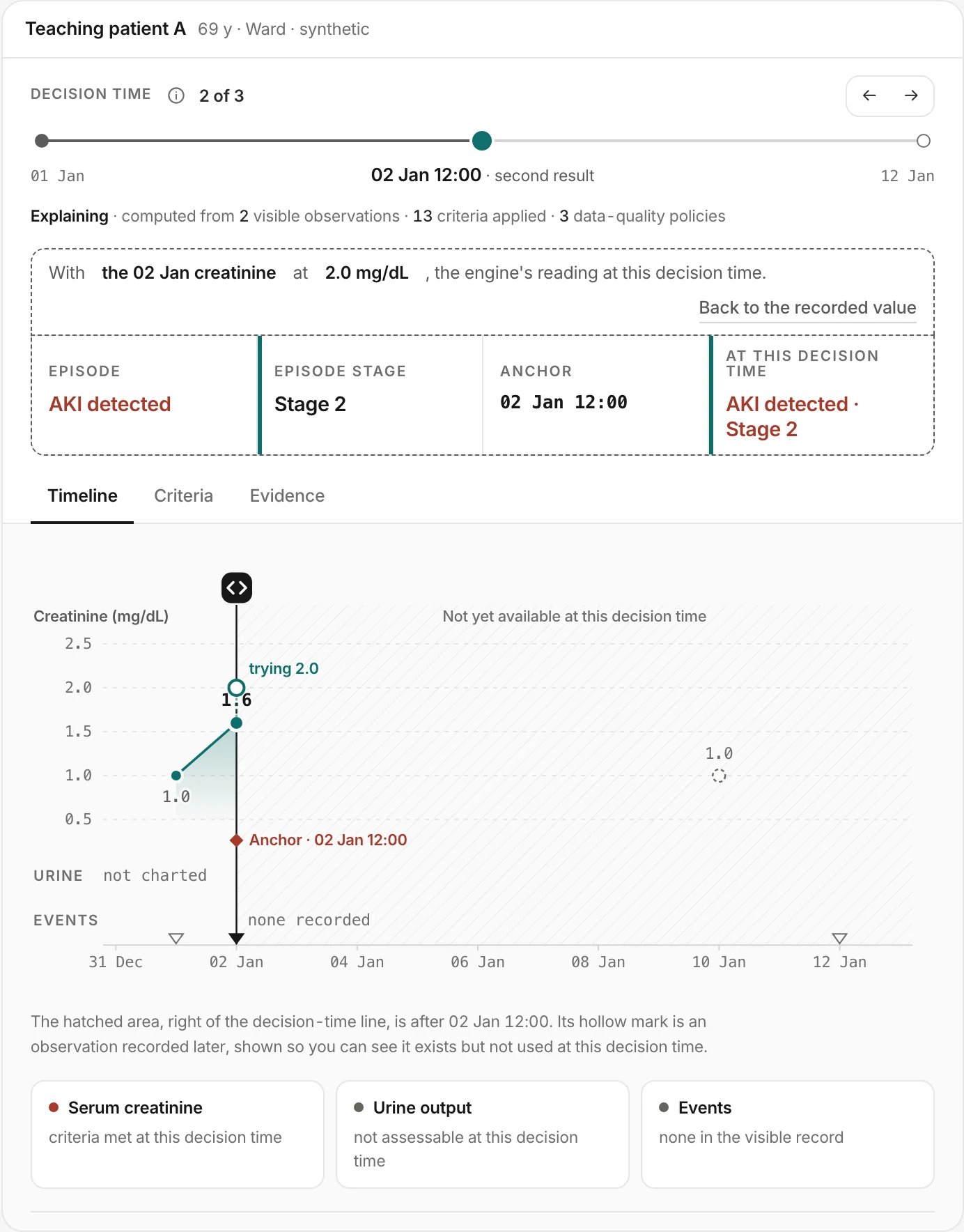
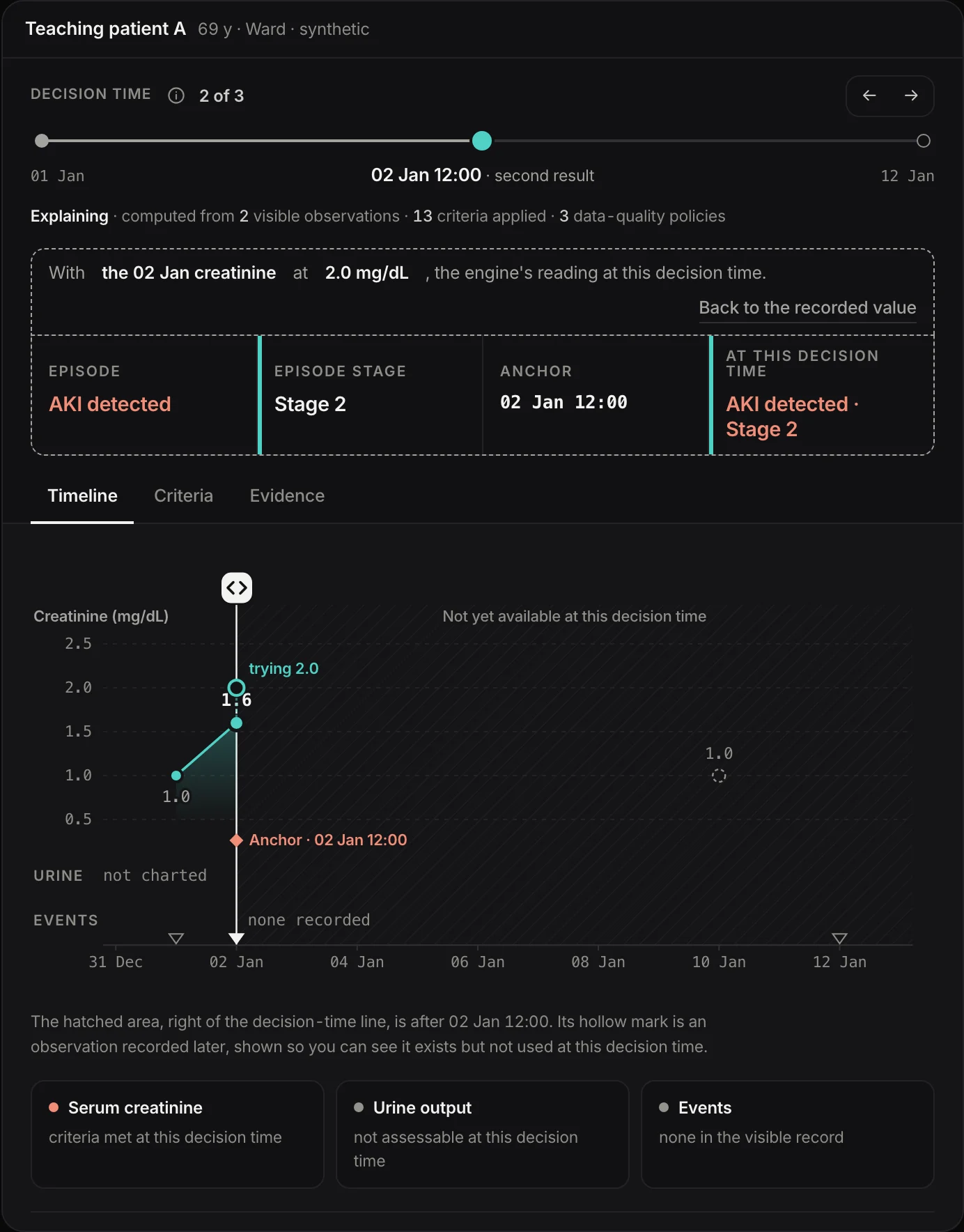
Drag the latest result across its range. The marks show where the engine's verdict changes: had the 02 Jan creatinine been 2.0 mg/dL, the reading would have been stage 2.
04
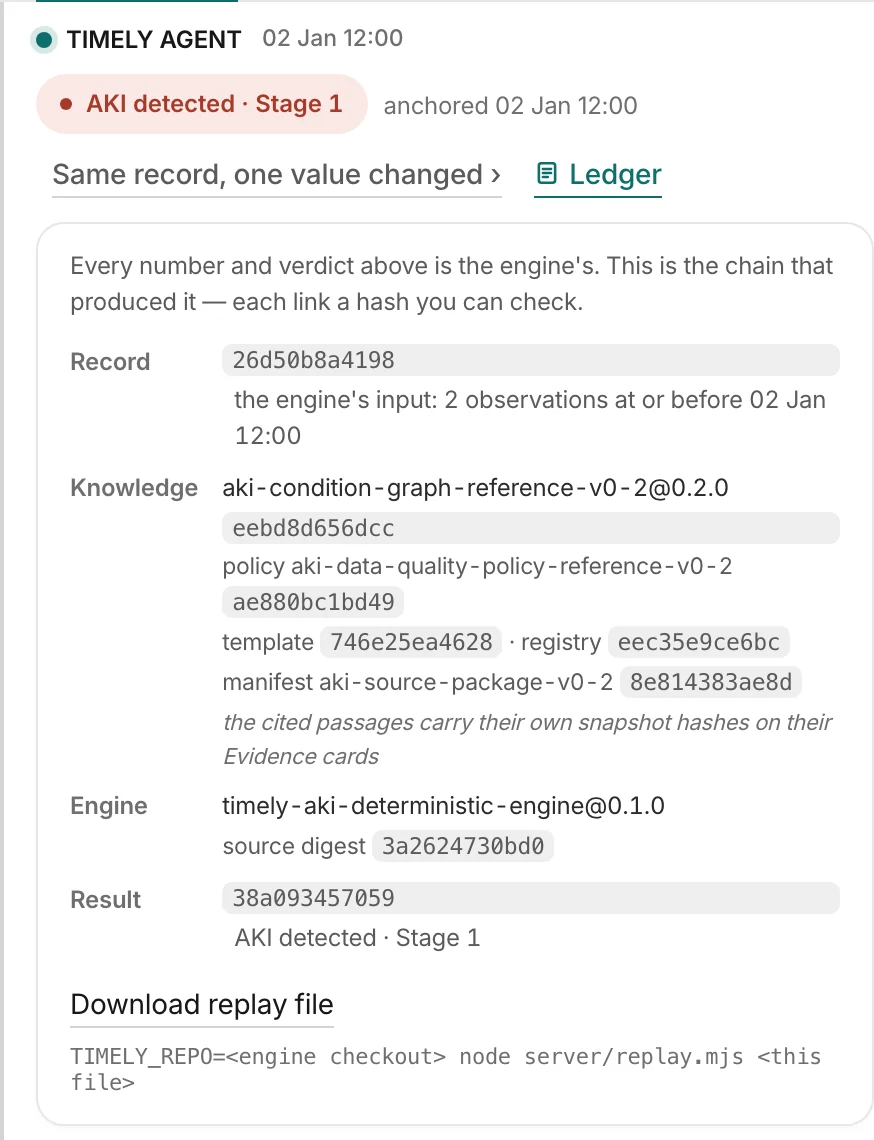
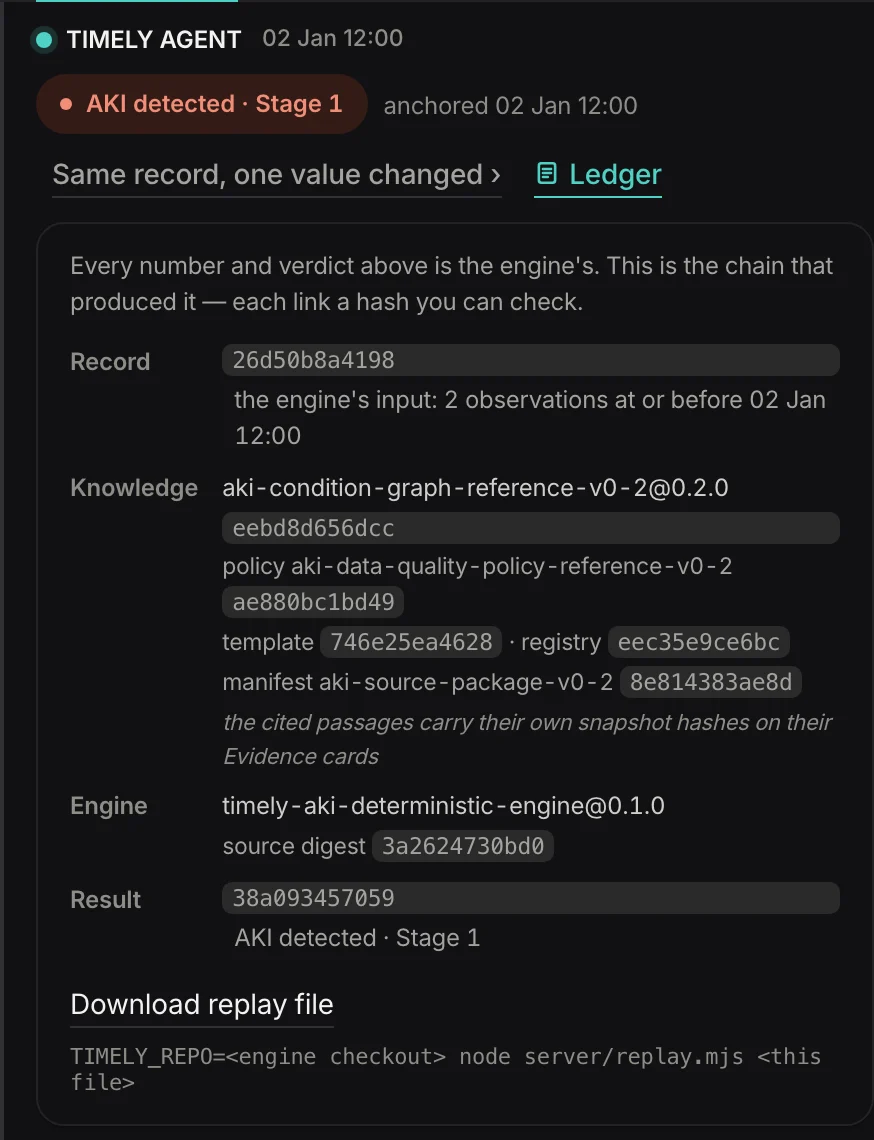
The ledger lists the hash of every link behind a conclusion: the record, the knowledge, the engine and the result. A replay file lets anyone rerun the engine and compare.
05
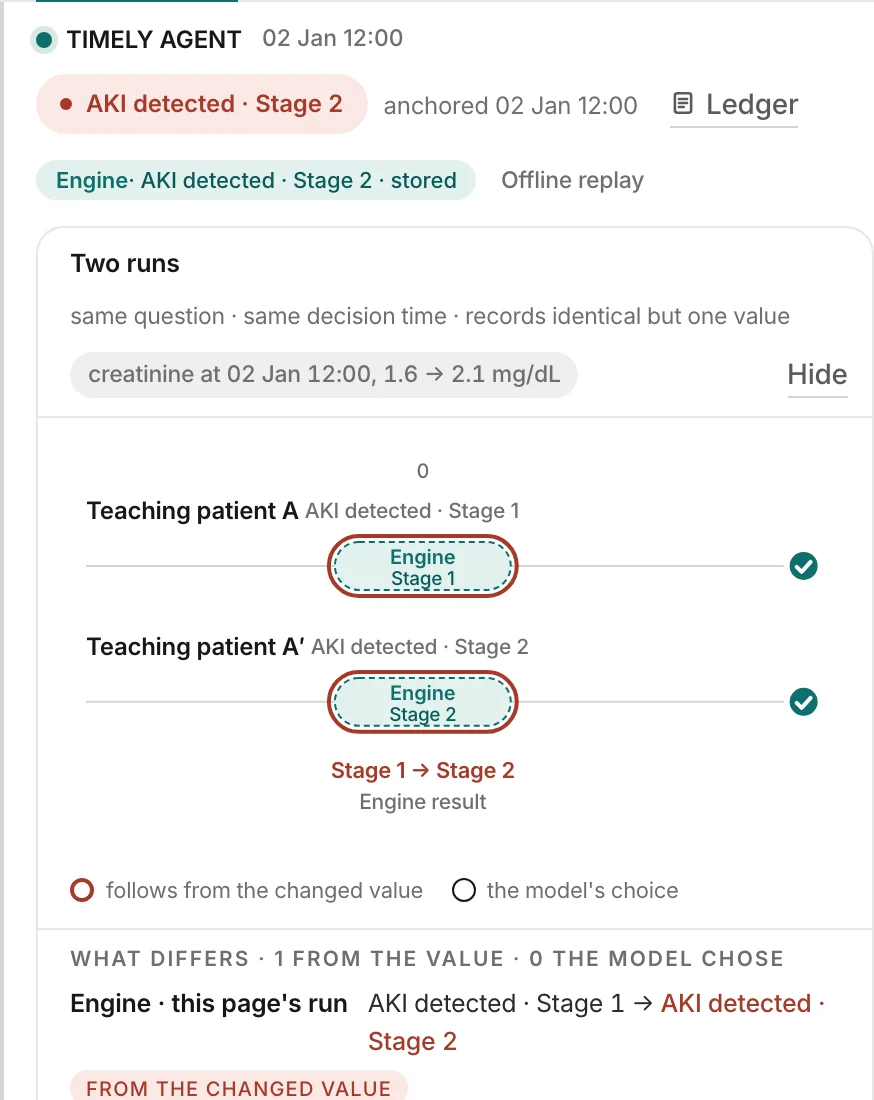
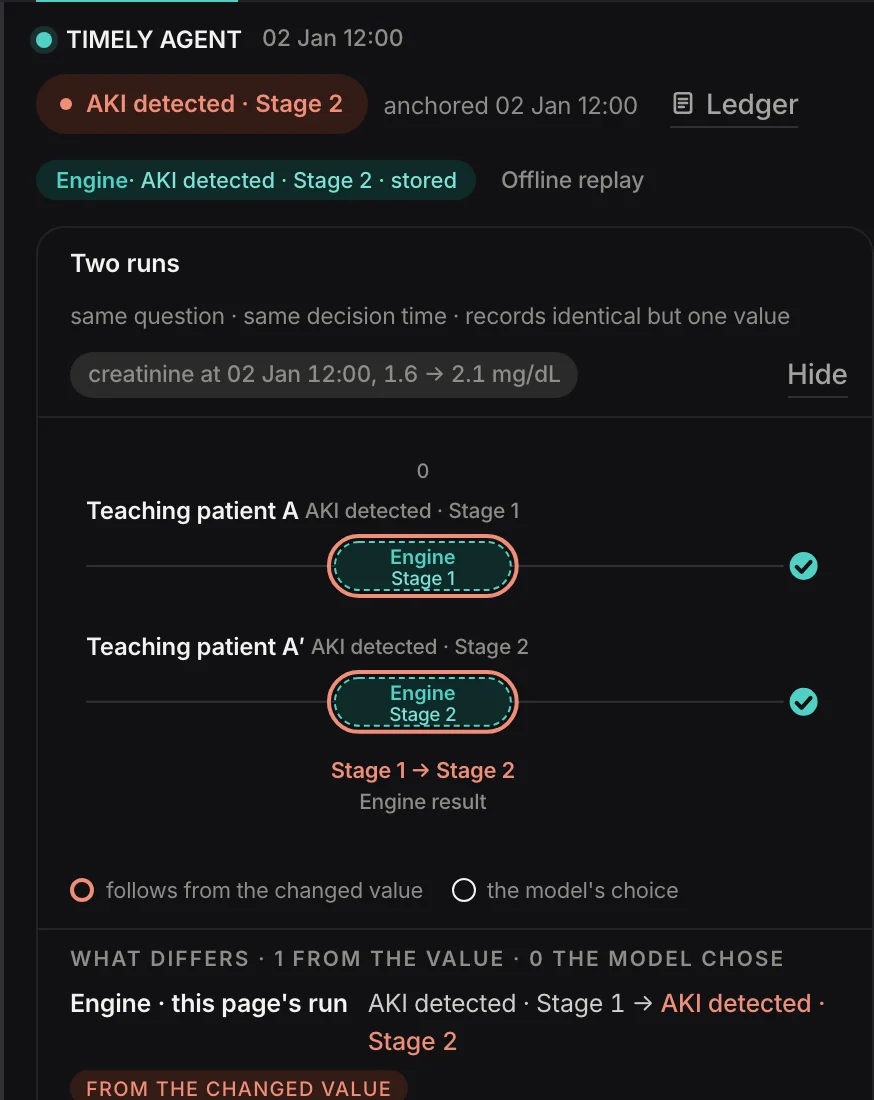
Ask the same question of a record with one value changed and follow both runs step by step, with each difference marked as coming from the value or from the model.
04Knowledge
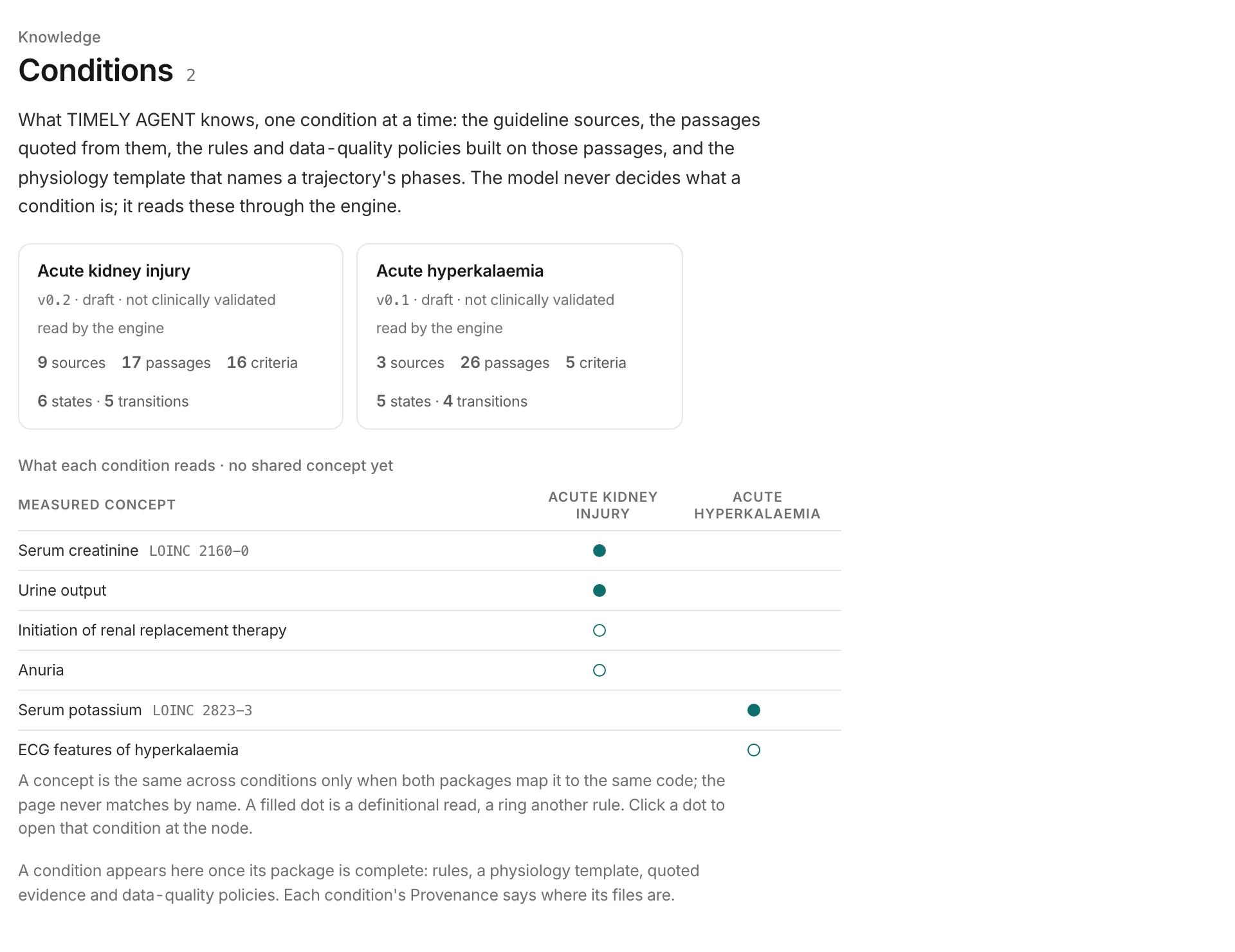
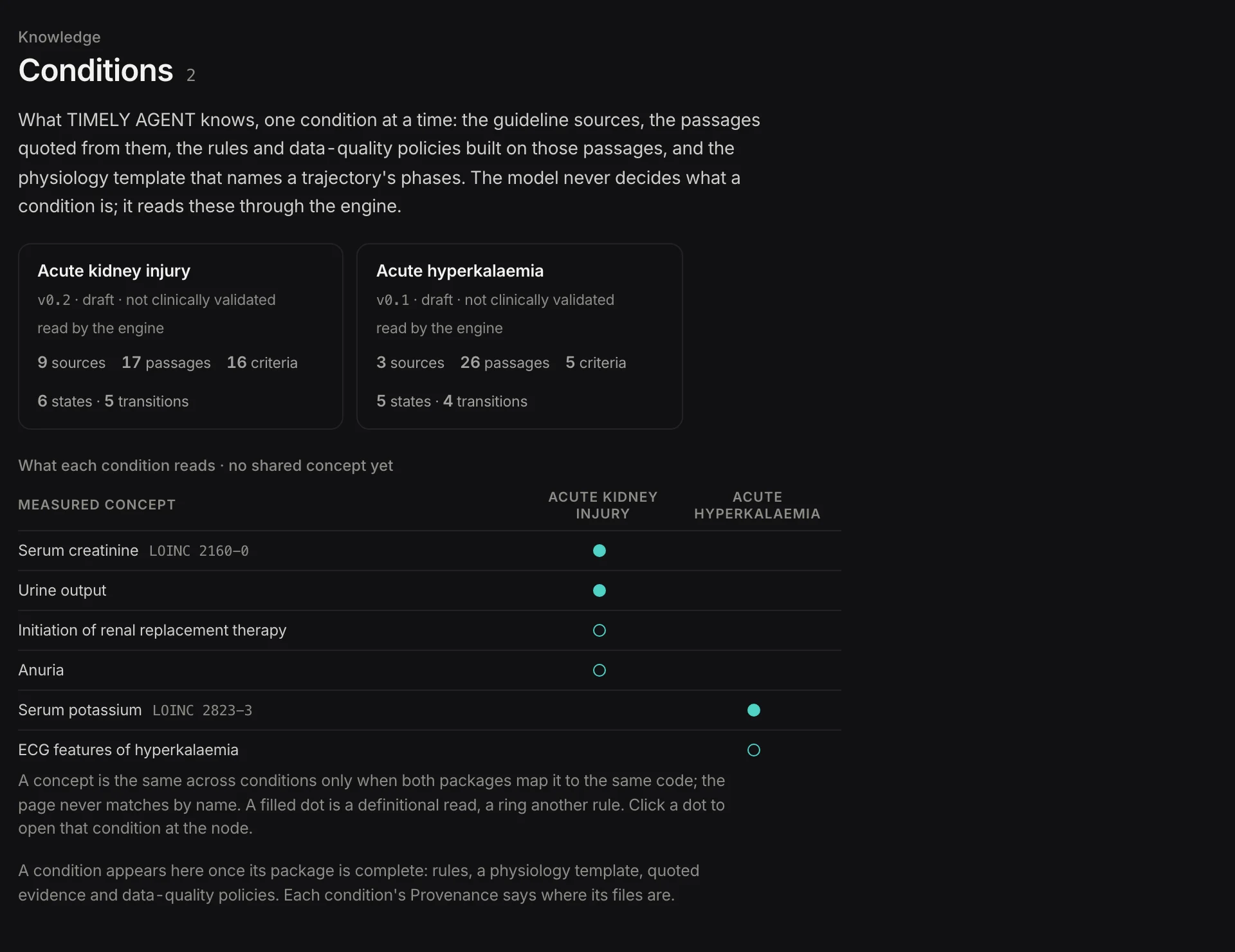
One record can be read for acute kidney injury and for hyperkalaemia. Each condition has its own knowledge pack, its own engine and its own verdict.
Stage 1 · Stage 2 · Stage 3
Increase in SCr by ≥0.3 mg/dl (≥26.5 μmol/l) within 48 hours
20db2b44ea22mild · moderate · severe
It is further classified by severity into mild (5.5-5.9 mmol/l), moderate (6.0-6.4 mmol/l) or severe (≥ 6.5 mmol/l).
c8eef6a55a95Passages are checked word for word against a hashed snapshot of the published guideline. Both knowledge packs are research drafts awaiting clinical sign-off.
05Boundaries
It reports what a guideline's criteria say about a record at a decision time. Decisions stay with clinicians.
When the record cannot answer, the verdict is not assessable, and the answer says what is missing.
The language model works with placeholders. Values are filled in on the machine that holds the record.
TIMELY AGENT is a research prototype, and every public example uses synthetic records.
06Research
TIMELY began as a framework for benchmarks of temporal clinical reasoning. Its arena poses questions to a language model at decision times on synthetic cases and scores each answer against the engine.
Arena in development · synthetic cases only
Open a synthetic teaching record, set the decision time and ask it a question. The demo runs in your browser.
Try the demo